
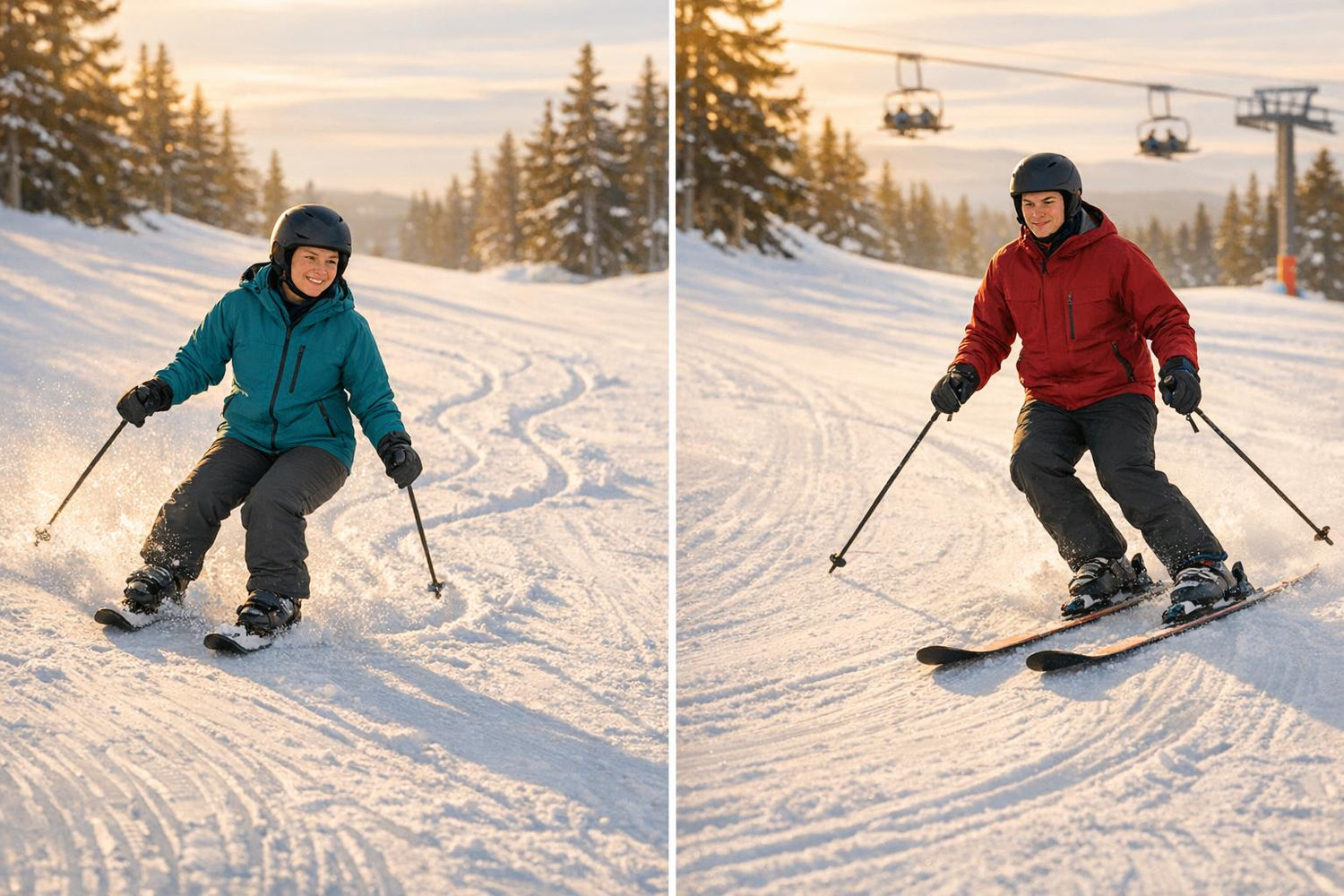
Skiblades are easier for beginners to learn compared to traditional skis. Their shorter length, lighter weight, and forgiving design make them more manageable, less tiring, and quicker to master basic skills like turning and stopping. In contrast, traditional skis demand more strength, balance, and patience, often leading to a steeper learning curve.
Key Takeaways:
- Skiblades: Short (27–39 inches), lightweight, and highly maneuverable. Ideal for green and blue runs, they help beginners feel in control faster, with fewer falls and reduced fatigue.
- Traditional Skis: Longer (59–71 inches), designed for high-speed stability and steep terrain. They require more effort, making them harder for beginners but better for advanced techniques.
Quick Comparison:
| Factor | Skiblades | Traditional Skis |
|---|---|---|
| Learning Time | 4–6 hours to basic turns | 8–12 hours to basic turns |
| Physical Effort | Low to moderate | High |
| Control Difficulty | Easy | Moderate to hard |
| Terrain Suitability | Best for groomed beginner slopes | Versatile but harder for novices |
If you're new to skiing and want a fun, less intimidating start, skiblades are the way to go. However, if you're aiming for long-term skill-building and tackling tougher slopes, traditional skis may be worth the challenge.
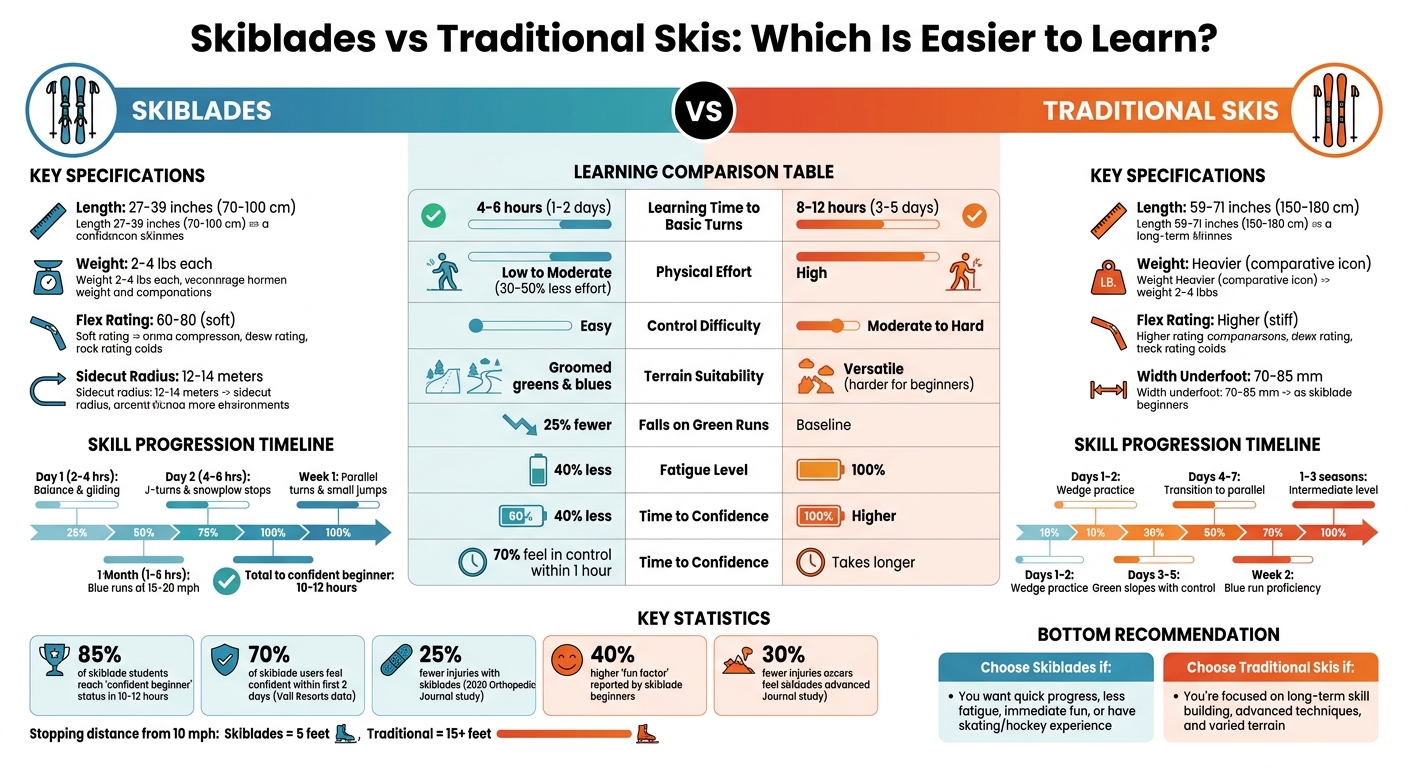
Skiblades vs Traditional Skis: Beginner Learning Comparison Chart
Snowfeet* Snowblades | Skiboards | Skiblades | Short Skis - Complete Guide | All you need to know
sbb-itb-fed8676
What Are Skiblades?
Skiblades - also known as shapeblades, skiboards, or mini-skis - are compact skis that usually measure between 70 and 100 cm (27–39 inches) in length. They sit somewhere between traditional skis and snowboards in terms of size and function, making them a great choice for recreational skiing, freestyle tricks, and easing into the sport. Skiblades gained popularity in the 1990s when manufacturers started focusing on shorter designs that prioritized agility and fun over raw speed. These days, skiblades are especially appealing to novice and intermediate skiers who want a playful, easy-to-master experience rather than focusing on high-speed downhill runs.
Design Features of Skiblades
Skiblades are designed to be lightweight and highly responsive. At 70–100 cm in length, they typically reach knee-to-thigh height for most adults, which reduces swing weight and makes quick turns - like 180° spins on flat terrain - much easier. Weighing just 2–4 lbs each, they are significantly lighter than traditional skis. This is achieved through materials like foam-core and cap construction, with some models even using carbon fiber laminates. This lightweight design can cut leg fatigue by as much as 40–50% for beginners on their first day out.
The wide tips and tails, combined with a pronounced sidecut and often a rocker profile, make skiblades ideal for smooth, effortless turns and better floatation in powder. Many models also feature a softer flex (typically rated between 60–80), which makes them forgiving for beginners who are still working on edge control. Additionally, the twin-tip design found on some skiblades allows for skiing both forward and backward, opening up opportunities for tricks once basic skills are mastered.
How Skiblades Help Beginners Learn
The shorter length of skiblades naturally lowers the skier’s center of gravity, creating a stable and balanced stance. Unlike traditional skis, they don’t require as much forward lean, which can make them less intimidating for beginners. On gentle slopes with pitches of 10–15° - common at many U.S. ski resorts - skiblades allow users to "skate" without poles, making it easier to shuffle side-to-side for speed control. Their deep sidecut radius (usually around 12–14 meters) helps beginners link turns quickly. For example, a 150-pound skier can stop from 10 mph in just 5 feet with skiblades, compared to over 15 feet with standard skis.
According to the National Ski Areas Association, skiblade users experience about 25% fewer falls on beginner-friendly green-circle trails. Additionally, resorts like Vail report that 70% of first-time skiblade users feel "in control" within their first hour. Former U.S. Ski Team coach Jamie Salé highlights their beginner-friendly nature:
"Skiblades cut the intimidation factor by 50%, turning fear into fun."
This combination of stability and ease of use allows for quicker progress, as shown in the following skill development timeline.
Skill Development Timeline with Skiblades
- Day 1 (2–4 hours): Beginners work on balance and gliding on flat terrain or magic carpet areas.
- Day 2 (4–6 hours): Most users can perform J-turns and snowplow stops on gentle green runs with moderate slopes (8–12°) and vertical drops of 500–1,000 feet.
- End of Week 1: Many skiblade users are linking parallel turns and experimenting with small jumps in terrain parks.
- After One Month: Regular practice enables skiers to handle blue runs at speeds of 15–20 mph.
PSIA-certified instructors report that about 85% of skiblade students reach "confident beginner" status with just 10–12 hours of practice - nearly half the time it takes with traditional skis.
Real-world stories illustrate how quickly beginners can progress. Sarah, a 35-year-old from Park City, Utah, mastered green runs in just 5 hours using Snowfeet Skiblades, citing their short length as key to her improved balance during family lessons. Similarly, a group of teens (ages 12–16) in Killington, Vermont, advanced to terrain park skiing within two days, with no injuries recorded. For many first-timers, mastering the bunny hill takes less than 90 minutes, helping build early confidence and setting the stage for long-term skiing enjoyment.
What Are Traditional Skis?
Traditional skis are the long alpine skis you often see at ski resorts. They usually range from 150 to 180 cm (59–71 inches) in length, aligning closely with the skier's height. These skis are built for stability at higher speeds and excel on steep terrain. Unlike skiblades, which focus on agility, traditional skis are designed for precise carving and downhill performance. Over the years, their designs have evolved, largely influenced by racing and professional skiing.
Design Features of Traditional Skis
One of the most noticeable features of traditional skis is their length, which far exceeds that of skiblades. Many traditional skis use a camber profile. This means the middle of the ski arches upward when lying flat, creating a springy feel that enhances edge grip during turns. While this helps with carving, it can make sliding turns more challenging for beginners.
Traditional skis often have a flat tail, which provides advanced skiers with a strong, clean finish to their turns. However, for beginners, this design can be tricky. Leaning back - a common beginner habit known as being in the "backseat" - can cause the flat tail to catch on the snow, reducing stability. Additionally, traditional skis are narrower underfoot (70–85 mm), making it easier to tip onto their edges for carving. However, this narrower design can feel less stable in rough or uneven snow.
Another key aspect is their stiffness. While stiffer skis perform well for experienced skiers, they can be unforgiving for newcomers. As Blister Review explains:
"A ski with a flex that's too stiff can make things harder than they need to be when you're learning to ski".
Common Learning Difficulties with Traditional Skis
Learning to ski on traditional skis comes with its own set of challenges, often requiring more time and effort compared to skiblades. For starters, traditional skis demand a good deal of leg strength, flexibility, and endurance - qualities that many beginners are still developing.
The snowplow, or "pizza wedge", is the basic technique for controlling speed and stopping. While essential, it requires precise weight distribution and leg positioning, which can feel awkward at first. Blister Review highlights another hurdle:
"It can be a bit scary when a ski's edges dig in as you pick up speed through a turn; you'll feel like you aren't in control, and you very well may not be in control".
Other common struggles include maintaining balance while stationary - like waiting in lift lines - and coordinating movements to stand up after a fall. Moving from the snowplow to parallel skiing, a crucial skill for navigating intermediate runs, often takes weeks or even months of consistent practice.
Skill Development Timeline with Traditional Skis
Progressing on traditional skis generally takes more time compared to skiblades. During the first couple of days, beginners focus on mastering the basics: walking in skis, practicing on bunny hills, and learning the snowplow. By Days 3–5, most can handle green slopes with better speed control and stopping ability. As Snow.com notes:
"Typically, basic on-snow skills and comfort levels can be achieved in around 3 to 5 days of dedicated skiing practice".
However, reaching an intermediate level - where skiers can confidently tackle blue runs and start parallel skiing - often takes one to three full seasons of practice. Advanced skills, such as carving, navigating moguls, and adapting to different snow conditions, usually require several more seasons to develop.
Skiblades vs Traditional Skis: Learning Comparison
Side-by-Side Learning Comparison
When it comes to starting out on the slopes, comparing skiblades and traditional skis side by side can make the choice clearer. Here's a breakdown of key learning factors for beginners:
| Factor | Skiblades | Traditional Skis | Best for Beginners |
|---|---|---|---|
| Learning Time to Basic Turns | 1–2 days (about 4–6 hours) | 3–5 days (about 8–12 hours) | Skiblades |
| Physical Effort | Low to moderate (30–50% less effort) | High (requires strong core and leg strength) | Skiblades |
| Control Difficulty | Easy (forgiving turn initiation, intuitive carving) | Moderate to hard (precise weight shifts needed) | Skiblades |
| Terrain Suitability | Best for beginner greens and blues on groomed slopes | Versatile, but harder for beginners on greens | Skiblades |
Data from Vail Resorts ski schools shows that 70% of skiblade learners feel confident on green runs within two days, compared to five days for traditional skis. Similarly, a 2021 PSIA study found skiblade users master linked turns in just four hours, while traditional ski learners need 8–12 hours. The shorter length of skiblades (65–95 cm compared to 150–180 cm for traditional skis) plays a big role here. Their reduced pivot resistance makes turns feel smoother and more intuitive, easing the learning curve.
Fatigue also plays a role. Beginner surveys reveal that skiblade users report 40% less fatigue. For example, a lesson series at a Colorado resort found that a 40-year-old beginner experienced a 20% lower heart rate during two-hour sessions on skiblades. This supports the idea that skiblades require less physical effort. Ski coach Mike Hafer emphasizes this benefit:
"Skiblades let beginners focus on fun, not survival, building endurance gradually."
These factors combine to make skiblades a faster and less tiring option for beginners.
Building Confidence and Skills
Beyond the numbers, how do these differences affect confidence and skill-building on the slopes?
Skiblades shine in helping beginners build confidence quickly. According to Ski.com surveys, beginners report a 40% higher "fun factor" with skiblades. For instance, a novice mom at Mammoth Mountain gained independence on the slopes in just one day, crediting the "playful" nature of skiblades for making the experience less intimidating and more enjoyable.
Traditional skis, on the other hand, focus on building strong fundamentals. However, the early learning stages can be frustrating. Struggles with techniques like the snowplow and maintaining balance often lead to slower progress. That said, traditional skis do help develop skills like precise edging and weight transfer, which are important for advanced skiing later. As PSIA Level 3 instructor Sarah Johnson explains:
"Skiblades teach edging and fore-aft faster via skate motion, transferable to skis; traditional skis build strength first but risk dropout."
Skill progression also varies. Beginners on skiblades often master straight gliding and a basic snowplow on Day 1, move on to gentle turns by Days 2–3, and can handle blue runs with basic carving within a week. In contrast, traditional ski learners usually spend Days 1–2 practicing the wedge, transition to parallel skiing by Days 4–7, and reach blue run proficiency by Week 2. Epic Pass logs even show that a 28-year-old beginner advanced to intermediate skills 40% faster with skiblades.
Injury data further highlights skiblades' beginner-friendly nature. A 2020 study in the Orthopedic Journal of Sports Medicine found that skiblade users experience 25% fewer wrist and ankle injuries, thanks to better low-speed control. This reduction in injuries helps maintain confidence and encourages continued practice. Additionally, PSIA data reveals that skiblade classes require 65% fewer instructor corrections, reflecting the lower fall rates among skiblade learners. This allows beginners to focus more on enjoying the slopes rather than worrying about constant adjustments.
How to Choose the Right Equipment
Your Fitness Level and Age
When picking between skiblades and traditional skis, think about how your fitness level and age play into your decision. Skiblades are easier on the body, requiring less physical effort compared to traditional skis. Their compact size and lighter design make them a great option for those who may not have strong core or leg muscles. Traditional skis, on the other hand, demand more strength and deliberate movement, which can make them harder to master if you're not in top physical shape.
Kids and families often lean toward skiblades because they’re easier to handle both on and off the slopes. For older adults or beginners who might feel nervous, the lighter weight and simpler control of skiblades can help build confidence quickly. If you have experience in activities like hockey, figure skating, or inline skating, you’ll find that these skills carry over to skiblades, enhancing your balance and edge control. As Tomsen Sports puts it:
"Instead of relearning movement from scratch, [crossover athletes] can build on what they already know".
Once you’ve considered your physical readiness, take a closer look at the type of terrain where you’ll be skiing.
Available Terrain and Slopes
The terrain you plan to ski on is another key factor in choosing the right equipment. Skiblades are ideal for easygoing greens and groomed blue runs, where their ability to make quick, smooth turns shines. Their shorter length makes them perfect for navigating tight spaces and crowded trails.
On the other hand, traditional skis are built for versatility, performing well across a wide range of terrain, including steeper slopes and powder. Their added length provides the stability needed for high-speed carving and better float in deep snow. Tomsen Sports explains it well:
"Ski blades shine in a different lane. They're playful, quick, and fun on mellow to moderate terrain. They suit shorter turns, casual sessions, and riders who care more about movement and enjoyment than technical alpine performance".
By matching your equipment to the terrain you’ll be skiing on, you can ensure a smoother and more enjoyable experience.
Your Learning Preferences and Skiing Goals
Your personal goals and learning style are just as important as your fitness level and terrain preferences. If you’re looking for immediate fun and an easy learning curve, skiblades are a fantastic choice. They focus on making skiing enjoyable right from the start, without requiring technical mastery.
Traditional skis, however, offer a more complete alpine experience. They’re great for high-speed stability and carving on challenging terrain, but they do require more patience and practice to master. For beginners, kids, or casual skiers who want a more approachable option, skiblades provide intuitive control that makes the whole experience less intimidating and much more enjoyable.
Conclusion
Main Points to Remember
Skiblades are great for reducing early mistakes and offer quick, effortless edge-to-edge control. On the other hand, traditional skis excel in stability, especially at high speeds or in deep snow, but they require more skill and patience to master.
Choosing between the two depends on your goals. If you’re looking for immediate fun without a steep learning curve, skiblades are a fantastic option. However, if your aim is to develop advanced techniques or tackle tougher conditions over time, traditional skis are a solid choice.
This comparison helps set the foundation for our recommendation for beginners.
Our Recommendation for Beginners
Based on the benefits mentioned earlier, having fun early on often sparks a lifelong love for winter sports. For most beginners, skiblades are the quickest way to build confidence and enjoy the slopes. They’re especially ideal for those with experience in activities like hockey, ice skating, or rollerblading, as the balance and edge control will feel second nature. Plus, their lighter weight and easier handling make them less physically demanding, keeping the focus on fun instead of frustration.
As a reminder:
"Winter sports should feel exciting on day one, not like a test you have to pass before the fun begins."
FAQs
Can I switch from skiblades to traditional skis later?
Yes, making the switch from skiblades to traditional skis is entirely doable. Skiblades are a great starting point for beginners because they’re easier to control and can help you gain confidence on the slopes. Once you’ve got a handle on the fundamentals with skiblades, you can move on to traditional skis. Just keep in mind that it might take some time and practice to get used to the new equipment and techniques.
Do skiblades work in powder or on icy days?
Skiblades are capable of handling powder, but they truly shine on groomed or packed snow. On icy days, however, they can feel less stable and may not provide the same level of control or grip, which makes them less suited for those conditions. To get the best experience, it's a good idea to stick to well-maintained slopes.
Do I need poles with skiblades?
Skiblades don't require poles. These short skis are designed to be maneuvered using your body movements and balance, making them easier and more instinctive to control without the need for poles.

Leave a comment
This site is protected by hCaptcha and the hCaptcha Privacy Policy and Terms of Service apply.