
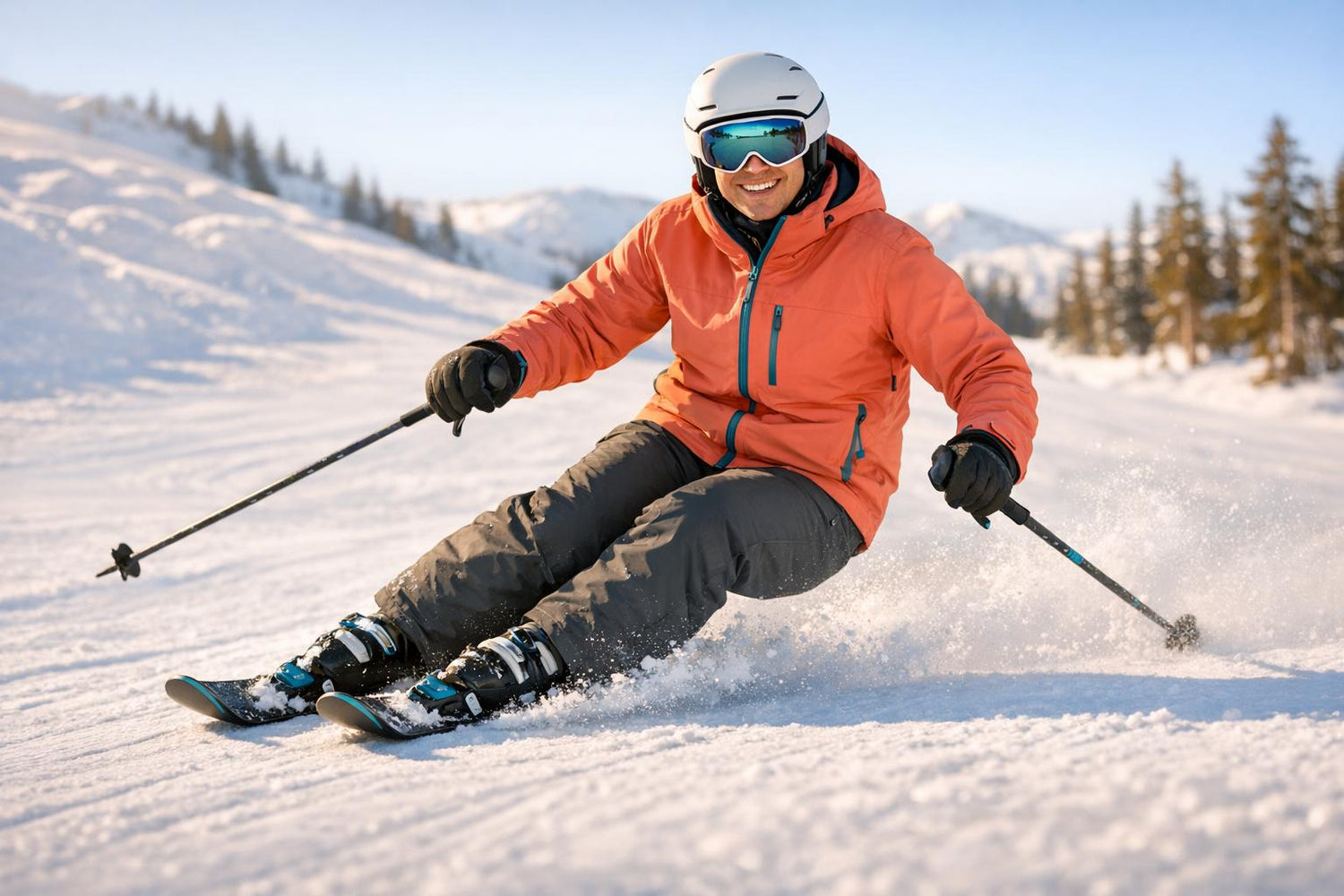
Short skis can help skiers feel more in control and confident on the slopes. A 2026 study found that skis measuring 65–120 cm improve maneuverability, reduce fatigue, and make it easier to navigate various terrains, especially for beginners. Here’s why they work:
- Easier Turns: Short skis allow for smoother, quicker turns, reducing hesitation.
- Less Fatigue: Lighter designs, like the Nordica Steadfast 75 CA (3.5 lbs), help conserve energy.
- Better Terrain Handling: Compact length improves control on groomed runs, moguls, and even snow parks.
Using tools like Carv sensors, researchers tracked confidence metrics such as turn shape, balance, and edge control. Results showed that short skis boosted both skill development and enjoyment across all skill levels. Models like Snowfeet Skiblades ($550–$950) offer a versatile option for anyone looking to improve their skiing experience.
How the Study Measured Skier Confidence
Measuring skier confidence goes beyond just tracking speed. Researchers needed a detailed method to evaluate both physical performance and how in control skiers felt. This approach combined real-time performance data with subjective perceptions of control.
Study Design and Participant Profile
The study involved 249 skiers with varying skill levels. Among them, 8% (n=20) were identified as experts, based on their extensive preparation - over 500 ski sessions and 620 miles annually. The rest of the participants ranged from beginners to intermediates, a group particularly influenced by factors like ski length. Testing took place on diverse terrain, including groomed runs, moguls, and off-piste paths, to observe how confidence changed with different conditions.
Key Confidence Metrics Tracked
Rather than focusing on one metric, the study examined several interconnected factors:
- Turn Shape: Rounded, S-shaped turns suggested stability and control, while skidded, Z-shaped turns indicated hesitation.
- Balance: Researchers assessed weight distribution within the ski boots, ensuring the skier’s center of gravity aligned with the skis to counteract momentum.
- Edging Control: This was particularly important on icy or steep sections, where maintaining a steady edge angle throughout turns directly impacted a skier’s sense of safety.
Fatigue emerged as a key factor contributing to technique breakdown. Poor balance, in particular, increased stress on the knees, reducing the skier’s ability to control speed and feel secure on slopes.
Measurement Tools and Methods
The study relied on Carv, a digital sensor system embedded in ski boot insoles, to deliver precise movement analysis. This tech tracked metrics like pressure distribution, edge angles, turn radius, and rotation rate, offering objective data to validate subjective feedback. Surveys collected after each run gauged skiers’ perceived control and fatigue, while terrain-specific performance tests measured versatility, responsiveness, forgiveness, and stability at speed.
Stomp It Tutorials, Ski Technique and Freestyle Camps, emphasized:
"The goal isn't numbers. It's learning to link sensation with outcome."
This philosophy guided the study’s interpretation of data, focusing not just on raw numbers but on how skiers experienced their equipment in real-world conditions.
sbb-itb-fed8676
Why Short Skis Lead to Better Control and Confidence
A recent study highlighted three major design elements that can boost control and help skiers feel more confident on the slopes. The findings showed that skiers using shorter skis felt more in control early on and maintained that confidence throughout the day.
Easier Turns and Edge-to-Edge Response
Shorter skis have a smaller effective edge, making it easier to initiate turns and transition between edges quickly. This means skiers can enjoy smoother, more effortless movements. GearJunkie tester Justin Park, who reviewed several short ski models for the 2026 season, shared:
"This edge-to-edge quickness is helpful for beginners."
Some models, like those featuring Amphibio technology, use an asymmetrical, rockered design to make edge transitions feel natural. According to Park, this predictability makes turning simpler, especially for those just starting out.
Less Physical Fatigue on the Slopes
Ski weight plays a big role in performance. For instance, the Nordica Steadfast 75 CA weighs only 3.5 lbs (1,600 g) by leaving out metal reinforcements, compared to over 4.2 lbs (1,900 g) for its metal-reinforced counterpart. Park explained:
"A light ski helps learning skiers by making it easier to move the skis around quickly and reducing fatigue throughout the day."
Lighter skis allow skiers to conserve energy and maintain proper form, making it easier to stay confident as the day progresses.
Better Agility on Difficult Snow Conditions
When tackling uneven terrain, quick reactions are key. Shorter skis naturally allow for faster redirection. The Line Pandora 92, which weighs about 3.6 lbs (1,630 g) per ski, was praised for its nimbleness in tight spaces like trees and moguls. Additionally, rounded tips and tails help prevent catching on soft or variable snow. A wider waist - typically around 85–94mm - paired with a shorter length improves flotation on unpredictable snowpack, creating a cushioned ride without losing responsiveness. These features are especially useful when venturing off groomed trails, helping skiers adapt to challenging conditions with ease. This added agility fosters quicker skill development and builds confidence on diverse terrain.
How Short Skis Performed Across Different Terrain Types
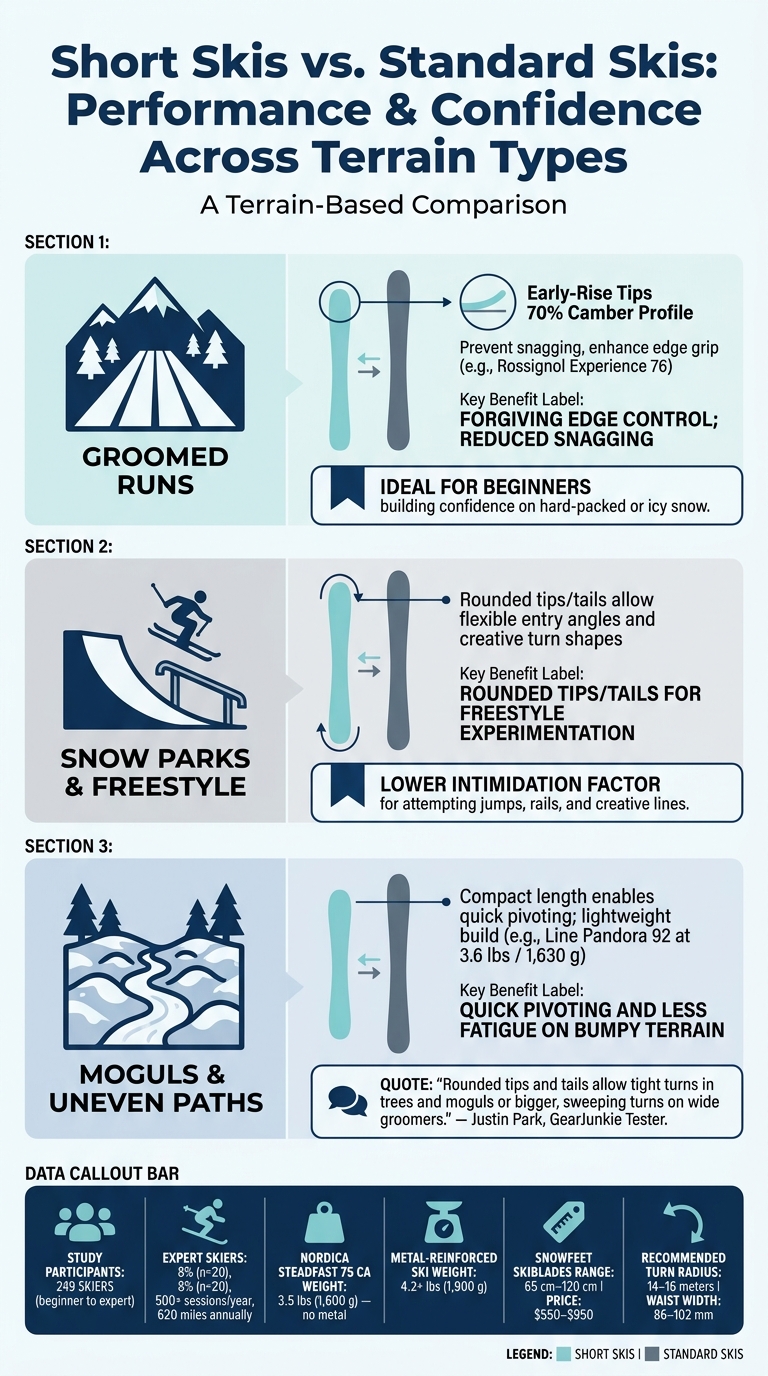
Short Skis vs. Standard Skis: Performance & Confidence Across Terrain Types
The 2026 study took a closer look at how short skis perform across various terrains, including groomed runs, snow parks, and moguls. These findings reveal how skiers of all skill levels can benefit from the unique features of short skis.
Groomed Runs: Benefits for Beginners
On smooth, groomed slopes, short skis provided a noticeable boost for beginners. Their early-rise tips and rockered outer edges help prevent snagging during turns - one of the most common issues that lead to hesitation or falls. This design makes carving feel more fluid and natural, rather than forced.
The camber underfoot, which is a slight upward curve in the ski's center, enhances edge grip on icy or hard-packed snow. A great example is the Rossignol Experience 76, which combines a 70% camber profile with a mild rocker. This blend offers a steady, grounded feel while still being easy to maneuver. For beginners, this stability helps build confidence, making it easier to transition to freestyle skiing in snow parks.
Snow Parks and Freestyle Skiing
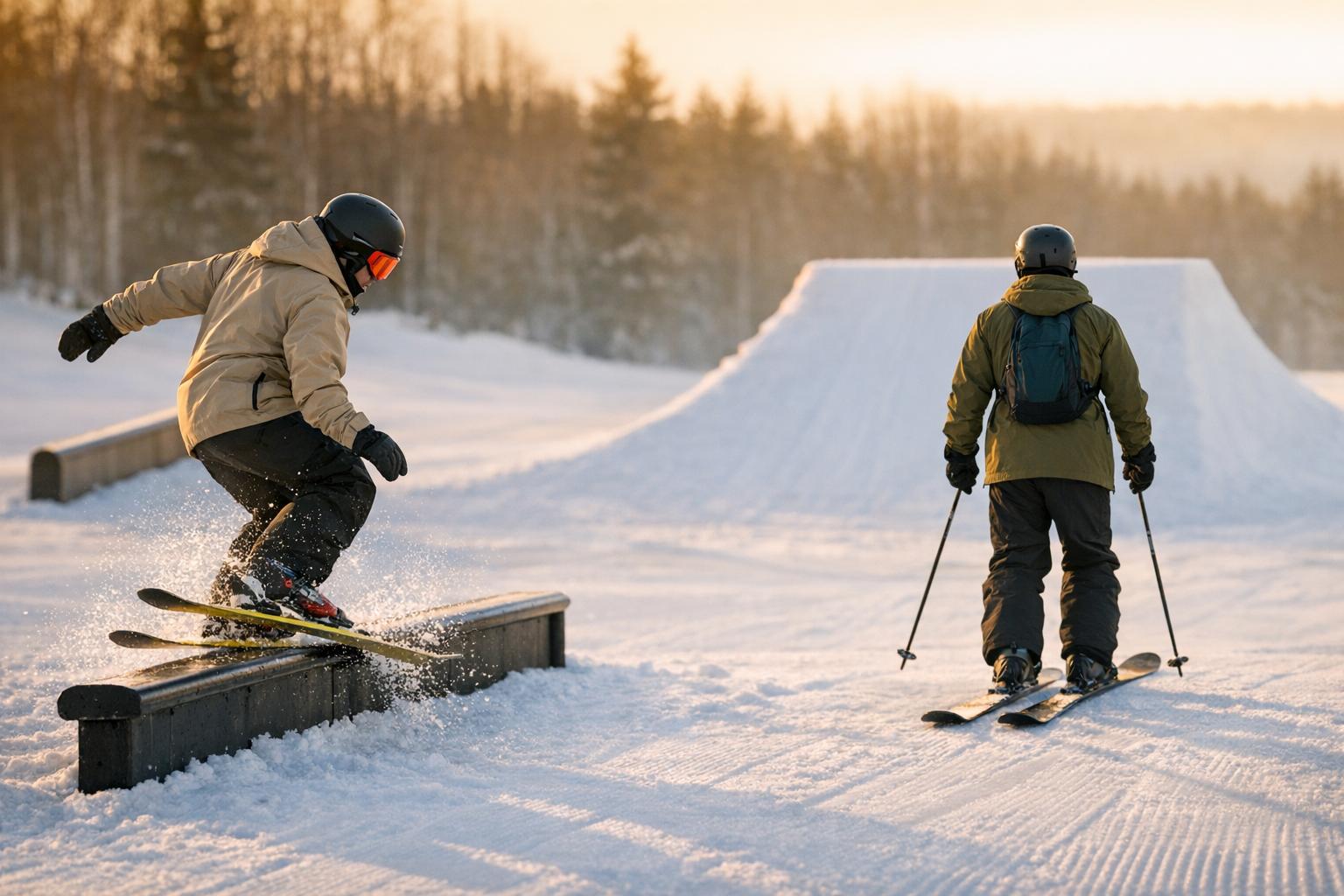
Short skis excel in snow parks thanks to their agile and playful designs. Features like rounded tips and tails allow skiers to experiment with different turn shapes and entry angles without being locked into a rigid path. This flexibility is perfect for freestyle skiing, where creativity and adaptability are key.
The shorter length also helps lower the intimidation factor when trying new tricks. With skis that feel more manageable, skiers are more likely to attempt jumps, rails, or creative lines. This same agility carries over to more unpredictable terrain, such as mogul fields.
Moguls and Uneven Paths
Mogul fields highlight the control and quick response that short skis offer. As GearJunkie tester Justin Park described:
"Rounded tips and tails... allow tight turns in trees and moguls or bigger, sweeping turns on wide groomers."
The compact length of short skis reduces the effort needed to navigate between bumps, making it easier to pivot and adjust quickly. Skiers can absorb impacts and reset their lines without feeling like the skis are working against them. Combined with their lightweight construction, this reduces muscle strain during a full run, helping skiers maintain sharp technique and confidence from start to finish.
| Terrain Type | Key Advantage |
|---|---|
| Groomed Runs | Forgiving edge control; reduced snagging |
| Snow Parks | Rounded tips/tails for freestyle experimentation |
| Moguls & Uneven Paths | Quick pivoting and less fatigue on bumpy terrain |
What These Findings Mean for Skiers
The terrain insights offer practical guidance, showcasing how shorter skis can boost confidence and improve the skiing experience for all skill levels.
Helping Beginners Progress Faster
For those new to skiing, shorter skis make the learning process much easier. Their lightweight design, such as the Nordica Steadfast 75 CA at around 3.5 lbs, helps reduce fatigue significantly, allowing beginners to focus on developing their skills rather than battling exhaustion. Less fatigue means more time on the slopes, which can lead to faster progress and a more enjoyable experience overall.
While shorter skis are ideal for beginners, they also provide benefits for seasoned skiers, offering enhanced agility and ease of use.
Short Skis Across All Skill Levels
Short skis aren't limited to helping beginners; they also appeal to more experienced skiers. These skis offer better maneuverability and require less physical effort, making them a versatile choice. For example, the Season Primer, named "Best Overall" for beginners, stands out for being "approachable and maneuverable while still allowing for progression". With a 14.5-meter turn radius, it delivers quick, controlled turns on groomed trails, making it a great option for intermediate skiers aiming to refine their technique.
Snowfeet Skiblades as a Confidence-Building Option
The benefits of shorter skis are epitomized in designs like Snowfeet Skiblades. These compact skis, ranging from 65 cm to 120 cm, are specifically crafted to build confidence and enhance responsiveness. Featuring a steel edge, a graphite base, and handcrafted wood construction, they combine durability with performance. Plus, they’re compatible with both ski and snowboard boots, making them an easy upgrade without requiring a full gear replacement. Prices for Snowfeet Skiblades start at $550 for the smallest size (65 cm) and go up to $950 for the largest model (120 cm), offering options that suit a variety of needs and terrains.
Conclusion: Key Takeaways from the 2026 Study
The 2026 study highlights how shorter skis can quickly build skier confidence by making turn initiation smoother, reducing fatigue, and handling different terrain with ease.
One standout finding is the impact of ski length and flex on overall performance. Skis with rockered tips, softer flex patterns, and lightweight builds - like those made with wood cores and no heavy metal layers - enable skiers to pivot effortlessly and recover from mistakes more easily. This translates to better control and a more confident experience on the slopes.
The research also challenges the idea that beginner skis are just a stepping stone. Whether carving on groomed runs, tackling moguls, or navigating snow parks, well-designed short skis provide room for growth, allowing skiers to improve without quickly outgrowing their gear. For those looking to progress, skis with a 14–16 meter turning radius and an 86–102 mm waist width are excellent choices.
FAQs
How do I pick the right short ski length for me?
Choosing the right length for short skis involves considering factors like your height, weight, skill level, and the type of terrain you’ll be skiing on. Short skis usually measure between 65 cm and 120 cm. If you’re a beginner or working on building your confidence, go for the shorter end of this range. These skis are easier to maneuver and can make it simpler to gain control across different terrains.
Will short skis feel stable if I go faster or ski steeper runs?
Short skis are often easier to control at slower speeds, which makes them a fantastic choice for beginners or those looking for a more playful skiing experience. However, they may feel less stable when you're skiing at higher speeds or tackling steeper terrain. If you're skiing aggressively and want more stability and confidence, longer skis are typically the better option.
Do I need special boots or bindings for Snowfeet Skiblades?
You don’t need any special boots or bindings to use Snowfeet Skiblades. They’re compatible with both ski boots and snowboard boots, making them simple to use and perfect for beginners.

Leave a comment
This site is protected by hCaptcha and the hCaptcha Privacy Policy and Terms of Service apply.